



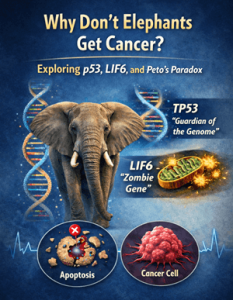
Looking for an engaging, real-world way to teach genetics, cancer biology, and evolution? This student-friendly article on why elephants rarely get cancer is a ready-to-use resource that brings abstract concepts to life using a fascinating biological mystery.
This lesson centers on two powerful genes, TP53 (p53) and LIF6. Students explore how gene regulation, apoptosis, and evolution work together to solve “Peto’s Paradox.” Or, why large, long-lived animals don’t have higher cancer rates than smaller ones. Students are naturally curious about elephants, and cancer resistance is a hook that gets them thinking deeply about biology. This story-driven approach makes complex molecular biology concepts understandable and relevant.
This resource includes a student-friendly article written at a high school level that explores elephant cancer resistance through the genes TP53 and LIF6. It also features comprehension questions and higher-order thinking prompts to support discussion and critical analysis, along with a complete answer key for easy grading. The content is strongly aligned with NGSS topics such as cell cycle regulation, gene expression, apoptosis, and evolution, making it easy to integrate into existing biology units.
What Students Will Learn:
- Why TP53 is called the “guardian of the genome”
- How elephants have 20 copies of TP53 compared to humans’ one
- The role of apoptosis in cancer prevention
- How the reactivated LIF6 “zombie gene” helps destroy damaged cells
- How this research connects to modern cancer science
Related Resources
Cancer: Out of Control Cells – a short article on tumor-suppressor genes
Mitosis and Cancer – data analysis on carcinogenesis where students analyze graphs
Cell Cycle Labeling – label the phases of the cell cycle, and cell structures associated with cell division
Investigation: Mitosis and Cancer – use slides of onion roots to estimate time spent in each phase
Mitosis, Cancer, and the HPV – slide deck for independent learning about human papillomavirus vaccines
