

Close Menu
bkngpnarnaul
  • Home
  • Education
    • Biology
    • Chemistry
    • Math
    • Physics
    • Science
    • Teacher
  • E-Learning
    • Educational Technology
  • Health Education
    • Special Education
  • Higher Education
  • IELTS
  • Language Learning
  • Study Abroad

Subscribe to Updates

Please enable JavaScript in your browser to complete this form.
Loading
What's Hot

Are Adapted Books Good or Bad?

December 12, 2025

Willamette University and Pacific University seek to merge

December 12, 2025

Free AI Use Policy Templates for Teachers

December 12, 2025
Facebook X (Twitter) Instagram
Friday, December 12
Facebook X (Twitter) Instagram Pinterest Vimeo
bkngpnarnaul
  • Home
  • Education
    • Biology
    • Chemistry
    • Math
    • Physics
    • Science
    • Teacher
  • E-Learning
    • Educational Technology
  • Health Education
    • Special Education
  • Higher Education
  • IELTS
  • Language Learning
  • Study Abroad
bkngpnarnaul
Home»Science»Venus fly traps’ death-grip trigger discovered
Science

Venus fly traps’ death-grip trigger discovered

adminBy adminSeptember 30, 20252 Comments4 Mins Read5 Views
Share Facebook Twitter Pinterest LinkedIn Tumblr Email WhatsApp Copy Link
Follow Us
Google News Flipboard Threads
Venus fly traps’ death-grip trigger discovered
Share
Facebook Twitter LinkedIn Pinterest Email Copy Link


Get the Popular Science daily newsletterđź’ˇ

Breakthroughs, discoveries, and DIY tips sent every weekday.

They’re the poster species for carnivorous plants and stuff of nightmares. Venus fly traps (Dionaea muscipula) are only native to North and South Carolina in the United States and can tell the difference between insects that pollinate them and those that make a good meal. Despite not having nerves themselves, they can detect touch from other organisms with highly sensitive sensory hairs. If they are touched twice in quick succession, their leaves will close and capture the prey. However, how the touch sensor of these plants works has been a mystery until now.

The root of this prey-catching technique is a chemical ion channel named DmMSL10 that surrounds the base of a Venus fly trap’s sensory hairs. This membrane allows chemicals to pass through and is the key sensor that detects the very faint touches by prey like flies, according to a study published today in the journal Nature Communications.

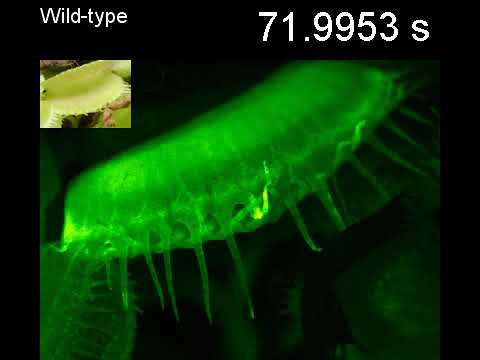
To see what is going on at the molecular level of these plants, a team from Japan’s Saitama University and the National Institute for Basic Biology, engineered flytraps that express a specific type of protein called GCaMP6f. They watched as a very gentle bend in the plant’s sensory hairs produced a local change to the electrical charges within the plants. 

Weak-deflection response in the sensory hair of a Venus fly trap. CREDIT: Masatsugu Toyota/Saitama University

By comparison, a stronger bend first creates a larger response from the electrical signal. Like flipping a lightswitch, once that electrical signal in the plant crosses a threshold, an all-or-none large electrical spike occurs alongside a chemical messenger in the plants called a Ca2+ wave.

The electrical signal and Ca2+ wave then travel from the hairy base of the plant up to the leaf blade. According to the team, the mechanism works similarly to an animal nervous system. 

“Our approach enabled us to visualize the moment a physical stimulus is converted into a biological signal in living plants,” study co-author and plant biologist Hiraku Suda said in a statement. 

Strong-deflection response in the sensory hair. CREDIT:Masatsugu Toyota/Saitama University

To look closer at this very tactile sensing system, the team genetically engineered a Venus fly trap that did not have the DmMSL10 ion channel that could pass along the electrical signal that tells the leaves to close. These plants had a much smaller response to stimuli, indicating that DmMSL10 works like an amplifier, boosting that initial small electrical signal until it is strong enough to trigger an action.
A lab-built ecosystem shows how leaf closures work when ants walk on the plants.
CREDIT: Masatsugu Toyota/Saitama University

A lab-built ecosystem shows how leaf closures work when ants walk on the plants.CREDIT: Masatsugu Toyota/Saitama University

To see how this could work in the wild, the team built a small ecosystem in the lab. Here, ants moved freely and walked over Venus fly traps that had their natural DmMSL10 ion channel and others that did not. In this simulated wild ecosystem, the ants’ touches triggered the reaction across the plants. The plants without the DmMSL10 ion channel had less frequent closures and less bending in the sensory hairs. Those with DmMSL10 closed on the ants more often and their sensory hairs bent more frequently.  

“Our findings show that DmMSL10 is a key mechanosensor for the highly sensitive sensory hairs that enable the detection of touch stimuli from even the faintest, barely grazing contacts,” says Suda. “Many plant responses arise from mechanosensing—the plant’s tactile sense—so the underlying molecular mechanisms may be shared beyond the Venus flytrap.”

 

More deals, reviews, and buying guides

The PopSci team has tested hundreds of products and spent thousands of hours trying to find the best gear and gadgets you can buy.


Laura is Popular Science’s news editor, overseeing coverage of a wide variety of subjects. Laura is particularly fascinated by all things aquatic, paleontology, nanotechnology, and exploring how science influences daily life.


Source link

deathgrip discovered fly News plants traps trigger Venus
Share. Facebook Twitter Pinterest LinkedIn Tumblr Email WhatsApp Copy Link
thanhphuchoang09
admin
  • Website

Related Posts

Science

‘They had not been seen ever before’: Romans made liquid gypsum paste and smeared it over the dead before burial, leaving fingerprints behind, new research finds

December 12, 2025
Science

How do you activate a supermassive black hole? A galaxy merger should do the trick

December 11, 2025
Science

Save hundreds on EF ECOFLOW solar generators and portable power stations with this limited Amazon deal

December 10, 2025
Education

Weekly Student News Quiz: High-Rise Fire, Word of the Year, ‘Stranger Things’

December 9, 2025
Science

A CDC panel has struck down universal newborn hepatitis B vaccination

December 8, 2025
Science

Why Are ADHD Rates On the Rise?

December 7, 2025
View 2 Comments

2 Comments

  1. Lola2499
    Lola2499 on September 30, 2025 6:54 pm

    https://shorturl.fm/gCvAQ

    Log in to Reply
  2. 🔎 💼 Balance Alert - 0.33 Bitcoin credited. Finalize reception >> https://graph.org/Get-your-BTC-09-11?hs=50b37fdb9fae0cc66bb8e47318589004& 🔎
    🔎 💼 Balance Alert - 0.33 Bitcoin credited. Finalize reception >> https://graph.org/Get-your-BTC-09-11?hs=50b37fdb9fae0cc66bb8e47318589004& 🔎 on October 1, 2025 4:01 pm

    cvnu5a

    Log in to Reply
Leave A Reply Cancel Reply

You must be logged in to post a comment.

Top Posts

Announcing the All-New EdTechTeacher Summer Learning Pass!

May 31, 202550 Views

Improve your speech with immersive lessons!

May 28, 202545 Views

Hannah’s Spring Semester in Cannes

May 28, 202539 Views

Weekly Student News Quiz: National Guard, Taylor Swift, Comets

October 13, 202533 Views
Don't Miss

How Do I Find A Study Abroad Program that Matches My Major?

By adminDecember 11, 20250

176 If you’re a college student planning to study abroad, your major is likely one…

Winter Holidays Around the World: Seasonal Celebrations Abroad

December 7, 2025

Introducing AIFS Abroad’s Spring 2026 Green Ambassadors

December 3, 2025

Meet Two People Who Did an Internship Abroad in Lisbon, Portugal

November 29, 2025
Stay In Touch
  • Facebook
  • Twitter
  • Pinterest
  • Instagram
  • YouTube
  • Vimeo

Subscribe to Updates

Please enable JavaScript in your browser to complete this form.
Loading
About Us
About Us

Welcome to Bkngpnarnaul. At Bkngpnarnaul, we are committed to shaping the future of technical education in Haryana. As a premier government institution, our mission is to empower students with the knowledge, skills, and practical experience needed to thrive in today’s competitive and ever-evolving technological landscape.

Our Picks

Are Adapted Books Good or Bad?

December 12, 2025

Willamette University and Pacific University seek to merge

December 12, 2025

Subscribe to Updates

Please enable JavaScript in your browser to complete this form.
Loading
Copyright© 2025 Bkngpnarnaul All Rights Reserved.
  • About Us
  • Contact Us
  • Disclaimer
  • Privacy Policy
  • Terms and Conditions

Type above and press Enter to search. Press Esc to cancel.