



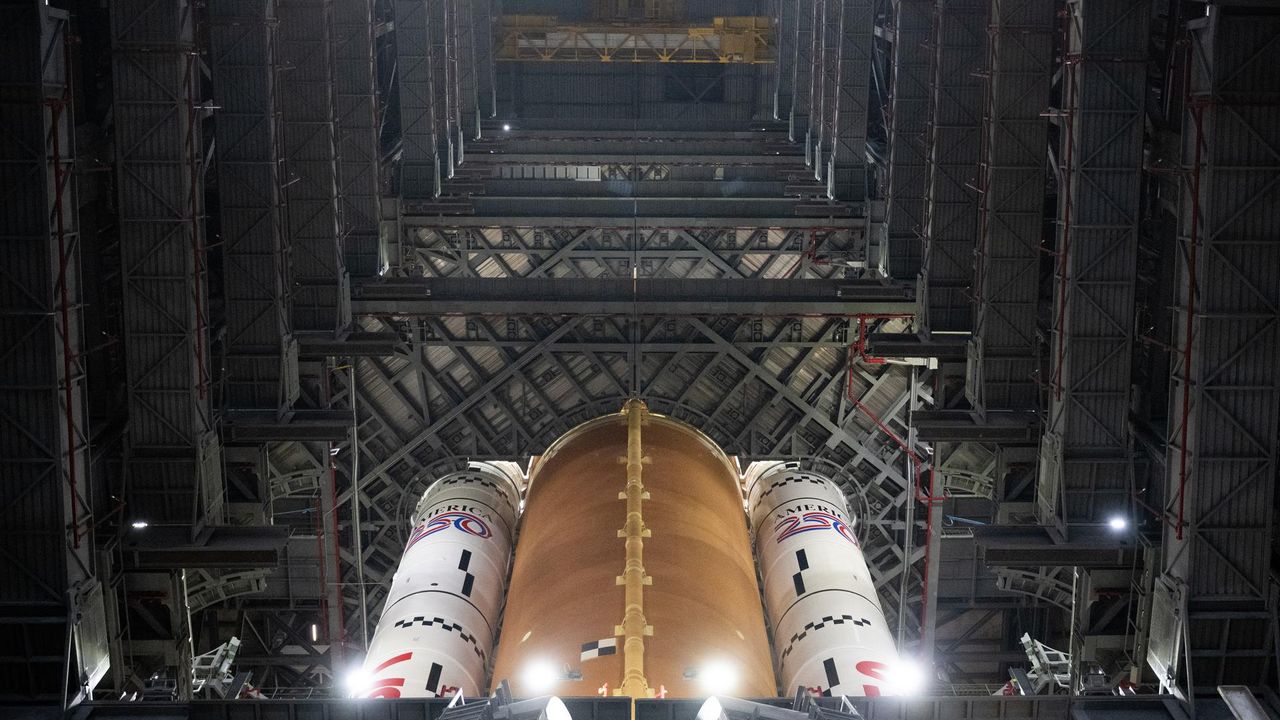
The first crewed moon mission in more than 50 years remains on track to launch as soon as Feb. 6.
NASA announced on Friday evening (Jan. 9) that it plans to roll the Space Launch System (SLS) rocket and Orion spacecraft that will fly the Artemis 2 moon mission out to the pad for prelaunch checks on Jan. 17, weather and technical readiness permitting.
“We are moving closer to Artemis 2, with rollout just around the corner,” Lori Glaze, acting associate administrator for NASA’s Exploration Systems Development Mission Directorate, said in a statement on Friday.
“We have important steps remaining on our path to launch, and crew safety will remain our top priority at every turn as we near humanity’s return to the moon,” she added.
Artemis 2 will send four astronauts — NASA’s Reid Wiseman, Victor Glover and Christina Koch and Jeremy Hansen of the Canadian Space Agency — on a 10-day trip around the moon and back to Earth.
Though it won’t land on, or enter orbit around, Earth’s nearest neighbor, Artemis 2 will mark humanity’s first trip to lunar realms since Apollo 17 in December 1972.
After the Artemis 2 stack reaches Pad 39B, technicians will subject the rocket and capsule to a variety of tests and checkouts. Chief among them is a fueling test known as a wet dress rehearsal.
“During wet dress, teams demonstrate the ability to load more than 700,000 gallons [2.65 million liters] of cryogenic propellants into the rocket, conduct a launch countdown, and practice safely removing propellant from the rocket without astronauts onsite,” NASA officials wrote in the statement.
Such tests do not always go smoothly. For example, wet dress rehearsals during the Artemis 1 mission revealed leaks of liquid hydrogen, which required multiple rollbacks to the VAB to address.
The launch of Artemis 1 was delayed significantly, from spring 2022 to November of that year. But the fixes worked: Artemis 1 was a success, sending an uncrewed Orion to lunar orbit and back to Earth.
Once the Artemis 2 wet dress is in the books, mission team members will hold a flight readiness review, which will assess the status of all systems required for a successful launch and mission around the moon. After that review, the team will announce an official target launch date.
That date will fall between Feb. 6 and April 10. But that two-month window holds just 15 potential launch dates, NASA explained in Friday’s statement.
The agency breaks the Artemis 2 launch window into three periods, each of which has a restricted set of possible liftoff dates:
- Launch Period Jan. 31 – Feb. 14: Launch opportunities Feb. 6, 7, 8, 10 and 11
- Launch Period Feb. 28 – March 1: Launch opportunities March 6, 7, 8, 9 and 11
- Launch Period March 27 – April 10: Launch opportunities April 1, 3, 4, 5 and 6
And there’s no guarantee that the SLS, Orion and/or launch teams will be ready to attempt a launch on all of those “green” days.
“In addition to the launch opportunities based on orbital mechanics and performance requirements, there are also limitations on which days within a launch period can be viable based on commodity replenishment, weather and other users on the Eastern Range schedule,” NASA officials said in the same statement. “As a general rule, up to four launch attempts may be attempted within the approximate week of opportunities that exist within a launch period.”
