

Close Menu
bkngpnarnaul
  • Home
  • Education
    • Biology
    • Chemistry
    • Math
    • Physics
    • Science
    • Teacher
  • E-Learning
    • Educational Technology
  • Health Education
    • Special Education
  • Higher Education
  • IELTS
  • Language Learning
  • Study Abroad

Subscribe to Updates

Please enable JavaScript in your browser to complete this form.
Loading
What's Hot

Spring Book Companions – Simply Special Ed

December 7, 2025

The AI Turn in Academic Research: A Free Guide for Faculty and Graduate Students

December 7, 2025

How To Create A Knowledge Base For Employee Development

December 7, 2025
Facebook X (Twitter) Instagram
Sunday, December 7
Facebook X (Twitter) Instagram Pinterest Vimeo
bkngpnarnaul
  • Home
  • Education
    • Biology
    • Chemistry
    • Math
    • Physics
    • Science
    • Teacher
  • E-Learning
    • Educational Technology
  • Health Education
    • Special Education
  • Higher Education
  • IELTS
  • Language Learning
  • Study Abroad
bkngpnarnaul
Home»Science»Mysterious Ritual Site From 5,500 Years Ago Reveals an Ancient Society in Upheaval : ScienceAlert
Science

Mysterious Ritual Site From 5,500 Years Ago Reveals an Ancient Society in Upheaval : ScienceAlert

adminBy adminNovember 9, 2025No Comments4 Mins Read2 Views
Share Facebook Twitter Pinterest LinkedIn Tumblr Email WhatsApp Copy Link
Follow Us
Google News Flipboard Threads
Mysterious Ritual Site From 5,500 Years Ago Reveals an Ancient Society in Upheaval : ScienceAlert
Share
Facebook Twitter LinkedIn Pinterest Email Copy Link


The dawn of the Bronze Age was a tumultuous time for many human societies, as the social order of the preceding Copper Age fell apart. Yet little is known about this pivotal period in human history, including why exactly it happened or how people handled it.

In a new study, researchers take a closer look at this transformative era through the lens of Murayghat, an ancient archaeological site located near the city of Madaba in what is now Jordan.

The Copper (or Chalcolithic) Age had seen sedentary farming communities proliferate around the Levant in the Middle East, along with key advances like copper mining and smelting. Around 5,500 years ago, however, many of these communities seem to have experienced some kind of upheaval, either shrinking or abandoning their settlements.

Related: A 3,000-Year-Old Workshop May Have Revealed The Origins of The Iron Age

Previous research suggests the culture may have collapsed due to a mix of climate change and social disruption. The Chalcolithic was reportedly humid, with trees growing in the now treeless Negev desert, and its culmination coincided with a regional shift toward a drier climate.

Emerging in this context, Murayghat stands out from the area’s earlier residential communities. It seems more like a place for ceremonial assemblies, says archaeologist and study author Susanne Kerner from the University of Copenhagen.
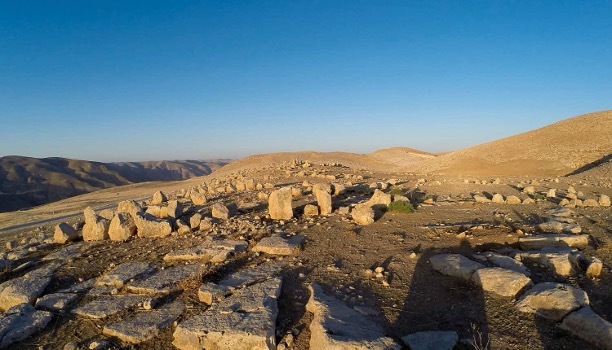
A collection of oblong shaped stones arranged loosely in lines, on top of a knoll with no vegetation. Nearby hills are in the background and the sky is blue.
The central knoll of Murayghat. (The Ritual Landscapes of Murayghat Project, Susanne Kerner)

“Instead of the large domestic settlements with smaller shrines established during the Chalcolithic, our excavations at Early Bronze Age Murayghat show clusters of dolmens, standing stones, and large megalithic structures that point to ritual gatherings and communal burials rather than living quarters,” Kerner says.

Dolmens, also known as portal tombs, are megalithic burial chambers typically consisting of two large vertical stones supporting a horizontal capstone. Kerner and her colleagues documented the remains of more than 95 dolmens at Murayghat dating to the Early Bronze Age, describing more than 70 of them in detail.
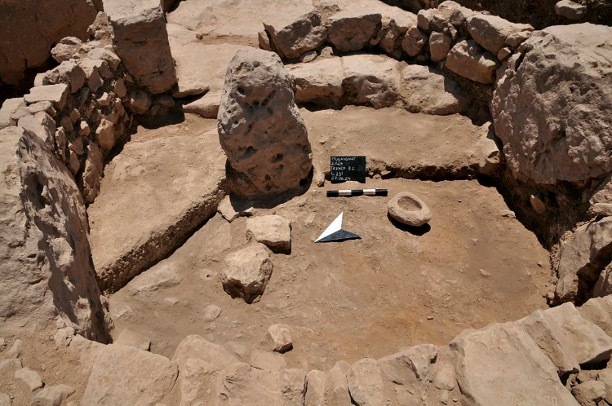
An oblong stone standing upright in the middle of circular stone walled enclosure with no roof. A mortar sits to the right of the central stone, and archeological markers have been placed at the base of the stone.
One of the standing stones at Murayghat, positioned inside a walled enclosure, with a large limestone mortar close by (right). (The Ritual Landscapes of Murayghat project, Maximilian Holmström)

Although none of the dolmens appear to contain any remains, their resemblance to better-preserved dolmen fields in the region suggests a ceremonial purpose.

In addition to this high density of dolmens, the site’s central hilltop is home to stone enclosures and carved bedrock that suggest ceremonial rather than residential use, Kerner reports. There is also little evidence of certain domestic amenities, such as hearths.

The architecture is a diverse mix of styles, which would be unusual for a residential site of this era. Yet it could be explained by different groups of people traveling to Murayghat and bringing their own traditions with them, Kerner points out.

The layout of the site and prominence of the dolmens support this interpretation, as do many of the artifacts found there. Pottery discovered at the site includes large communal bowls, for example, along with other items associated with rituals and feasting.

While a drying climate may have reshuffled the sociopolitical landscape of the late Chalcolithic Levant, it did not force people out of the area entirely. Some places evidently did suffer steep declines or even depopulation, but people also found ways to persevere.

“People had to find mechanisms to deal with a situation in which the traditional values and patterns of behaviour no longer worked,” Kerner writes. “Thus, new ways to organize life (and death) had to be found, and found within a society with weak hierarchical structures, still dealing with a major disruption to everyday patterns of life.”

Win a $10,000 Space Coast Adventure Holiday

Details about those adaptations remain elusive today, and after all these thousands of years, we may never truly understand what was going on at Murayghat in the Early Bronze Age.

It’s worth trying to learn what we can, however, to illuminate how ancient people dealt with such dramatic turmoil, especially given the relative abundance of clues preserved at Murayghat.

“Murayghat gives us, we believe, fascinating new insights into how early societies coped with disruption by building monuments, redefining social roles, and creating new forms of community,” Kerner says.

The study was published in Levant: The Journal of the Council for British Research in the Levant.


Source link

Ancient MSFT Content Mysterious Reveals Ritual ScienceAlert Site society Upheaval years
Share. Facebook Twitter Pinterest LinkedIn Tumblr Email WhatsApp Copy Link
thanhphuchoang09
admin
  • Website

Related Posts

Science

Why Are ADHD Rates On the Rise?

December 7, 2025
Science

Supercomputer Creates One of The Most Realistic Virtual Brains Ever Seen : ScienceAlert

December 6, 2025
Science

AI can influence voters’ minds. What does that mean for democracy?

December 5, 2025
Science

World’s Largest ADHD Treatment Review Reveals What Really Works

December 4, 2025
Science

Monumental Roman basin hidden for 2,000 years unearthed near Rome

December 3, 2025
Science

An extra solar system planet once orbited next to Earth — and it may be the reason we have a moon

December 2, 2025
Add A Comment
Leave A Reply Cancel Reply

You must be logged in to post a comment.

Top Posts

Announcing the All-New EdTechTeacher Summer Learning Pass!

May 31, 202548 Views

Improve your speech with immersive lessons!

May 28, 202545 Views

Hannah’s Spring Semester in Cannes

May 28, 202538 Views

Weekly Student News Quiz: National Guard, Taylor Swift, Comets

October 13, 202532 Views
Don't Miss

Winter Holidays Around the World: Seasonal Celebrations Abroad

By adminDecember 7, 20250

111 For many people, winter involves travel and new experiences—whether that means escaping the cold…

Introducing AIFS Abroad’s Spring 2026 Green Ambassadors

December 3, 2025

Meet Two People Who Did an Internship Abroad in Lisbon, Portugal

November 29, 2025

Tyler’s Fall Semester Abroad in Budapest

November 25, 2025
Stay In Touch
  • Facebook
  • Twitter
  • Pinterest
  • Instagram
  • YouTube
  • Vimeo

Subscribe to Updates

Please enable JavaScript in your browser to complete this form.
Loading
About Us
About Us

Welcome to Bkngpnarnaul. At Bkngpnarnaul, we are committed to shaping the future of technical education in Haryana. As a premier government institution, our mission is to empower students with the knowledge, skills, and practical experience needed to thrive in today’s competitive and ever-evolving technological landscape.

Our Picks

Spring Book Companions – Simply Special Ed

December 7, 2025

The AI Turn in Academic Research: A Free Guide for Faculty and Graduate Students

December 7, 2025

Subscribe to Updates

Please enable JavaScript in your browser to complete this form.
Loading
Copyright© 2025 Bkngpnarnaul All Rights Reserved.
  • About Us
  • Contact Us
  • Disclaimer
  • Privacy Policy
  • Terms and Conditions

Type above and press Enter to search. Press Esc to cancel.