

Close Menu
bkngpnarnaul
  • Home
  • Education
    • Biology
    • Chemistry
    • Math
    • Physics
    • Science
    • Teacher
  • E-Learning
    • Educational Technology
  • Health Education
    • Special Education
  • Higher Education
  • IELTS
  • Language Learning
  • Study Abroad

Subscribe to Updates

Please enable JavaScript in your browser to complete this form.
Loading
What's Hot

Creating an Environment Where Parents Want to Collaborate

January 23, 2026

Inside AI Literacy: Habits of AI-Literate Students

January 23, 2026

Introducing Coursera’s Job Skills Report 2026: The most critical skills the world’s learners need this year

January 23, 2026
Facebook X (Twitter) Instagram
Friday, January 23
Facebook X (Twitter) Instagram Pinterest Vimeo
bkngpnarnaul
  • Home
  • Education
    • Biology
    • Chemistry
    • Math
    • Physics
    • Science
    • Teacher
  • E-Learning
    • Educational Technology
  • Health Education
    • Special Education
  • Higher Education
  • IELTS
  • Language Learning
  • Study Abroad
bkngpnarnaul
Home»Science»JWST delivers 1st weather report of nearby world with no sun — stormy and covered with auroras
Science

JWST delivers 1st weather report of nearby world with no sun — stormy and covered with auroras

adminBy adminOctober 1, 20252 Comments3 Mins Read9 Views
Share Facebook Twitter Pinterest LinkedIn Tumblr Email WhatsApp Copy Link
Follow Us
Google News Flipboard Threads
JWST delivers 1st weather report of nearby world with no sun — stormy and covered with auroras
Share
Facebook Twitter LinkedIn Pinterest Email Copy Link


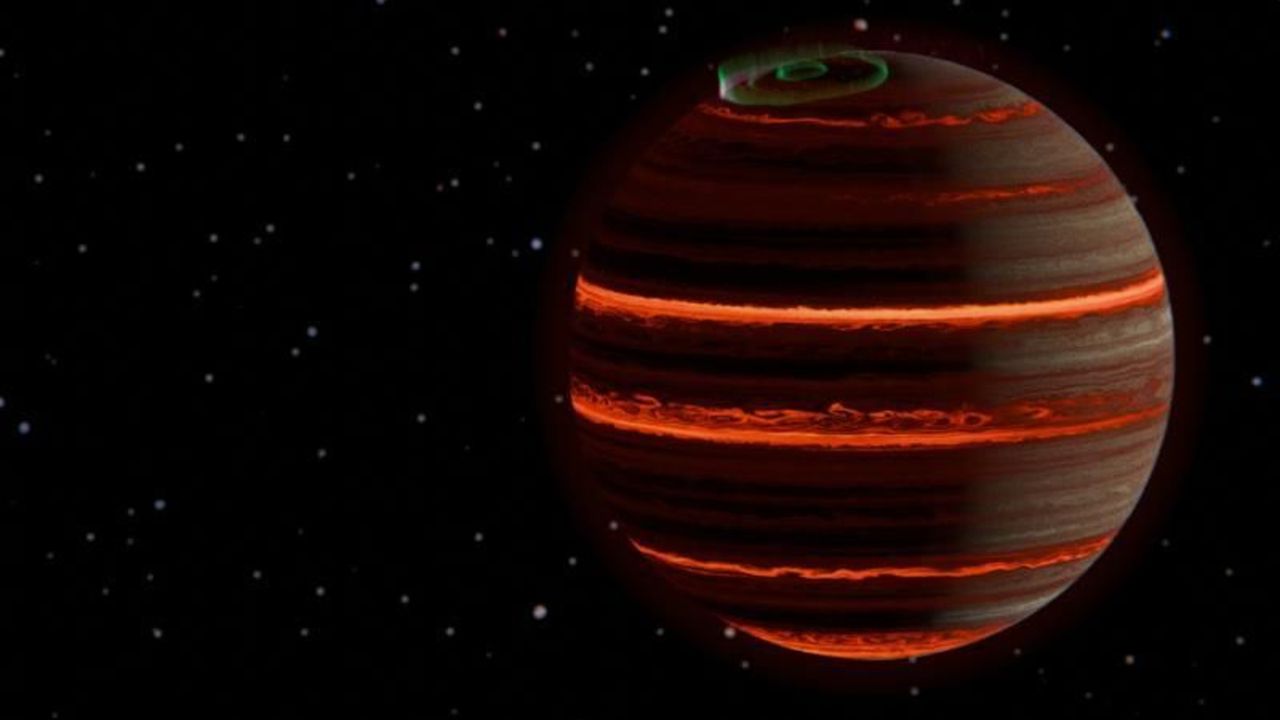
The latest weather forecast doesn’t come from Dublin, London or New York — it comes from deep space, where a lonely world drifts without a sun and glows with auroras more dazzling than Earth’s northern lights.

The world, called SIMP-0136, is about 200 million years old and lies about 20 light-years away in the constellation Pisces. It isn’t quite a world nor a star. Astronomers classify it as a brown dwarf, sometimes dubbed “failed stars.” Like stars, this world forms from collapsing clouds of gas, but it never grows massive enough to sustain hydrogen fusion in its core — the defining trait of a star.

And unlike Earth, SIMP-0136 doesn’t orbit its own sun. It’s a rogue world that spins once every two and a half hours as it floats freely through space. Now, thanks to the James Webb Space Telescope (JWST), astronomers have delivered the most detailed “weather report” yet for this strange world, tracking subtle changes in its atmosphere over a full rotation.


You may like

The study, published Sept. 26 in the journal Astronomy & Astrophysics, is the first to track how a brown dwarf’s atmosphere changes as it spins, revealing shifts in temperature, chemistry and clouds. Astronomers say the findings open a new window onto the weather of worlds beyond our solar system.

“These are some of the most precise measurements of the atmosphere of any extra-solar object to date, and the first time that changes in the atmospheric properties have been directly measured,” study lead author Evert Nasedkin of the Trinity College Dublin in Ireland said in a statement.

“Understanding these weather processes will be crucial as we continue to discover and characterise exoworlds in the future,” study co-author Johanna Vos of Trinity College Dublin said in the same statement.

The JWST’s sensitive instruments captured minute changes in brightness as SIMP-0136 spun, letting scientists map its atmospheric layers. Astronomers had long suspected the flickering light came from patchy clouds. Instead, the study found that SIMP-0136’s clouds, made of sand-like grains of hot silicates, are remarkably stable.

Breaking space news, the latest updates on rocket launches, skywatching events and more!

The real drama was instead unfolding higher up in the atmosphere, where the team discovered a layer of air nearly 570 degrees Fahrenheit (300 degrees Celsius) warmer than models predicted. According to the study, the extra warmth is most likely caused by auroras.

On Earth, auroras appear as shimmering curtains of light when charged particles from the solar wind interact with our world’s magnetic field. On SIMP-0136, however, a much stronger magnetic field supercharges this effect, with charged particles slamming into the atmosphere so forcefully that they not only glow but also pump energy into the air itself, heating the world’s upper layers.

JWST also detected tiny temperature swings of less than 40 degrees Fahrenheit (5 degrees Celsius) in deeper layers, the study notes. Those tiny temperature changes might be caused by huge storm systems, possibly like Jupiter’s Great Red Spot, moving across the surface as the world spins, scientists say.

Because brown dwarfs like SIMP-0136 aren’t swamped by the glare of a parent star, they serve as ideal stand-ins for giant exoworlds that orbit distant suns. By studying their weather in such detail, astronomers are beginning to piece together how atmospheres behave on distant worlds.

With JWST and future observatories such as the Extremely Large Telescope and NASA’s planned Habitable Worlds Observatory, astronomers hope to use the same techniques on worlds orbiting distant stars and uncover how their weather shifts and evolves over time.

A study about these results was published on Sept. 26 in the journal Astronomy and Astrophysics.


Source link

1st auroras covered delivers JWST nearby report stormy Sun Weather World
Share. Facebook Twitter Pinterest LinkedIn Tumblr Email WhatsApp Copy Link
thanhphuchoang09
admin
  • Website

Related Posts

E-Learning

Introducing Coursera’s Job Skills Report 2026: The most critical skills the world’s learners need this year

January 23, 2026
Science

A black hole ‘feeding frenzy’ could help explain a cosmic mystery uncovered by the James Webb Space Telescope

January 23, 2026
Science

Japanese snow monkeys get more than just relief from hot springs

January 22, 2026
Science

Super Savings on This Unique Air Fryer That Cooks Food in Heatproof Glass

January 21, 2026
Science

This tool-using cow defies expectations for bovine braininess

January 20, 2026
Science

NASA’s Artemis II mission to the moon is inching toward the launch pad

January 19, 2026
View 2 Comments

2 Comments

  1. ✂ 📥 Balance Update - 0.8 Bitcoin credited. Secure transfer => https://graph.org/Get-your-BTC-09-11?hs=15448349c22ceb4a6f37f795309ab14f& ✂
    ✂ 📥 Balance Update - 0.8 Bitcoin credited. Secure transfer => https://graph.org/Get-your-BTC-09-11?hs=15448349c22ceb4a6f37f795309ab14f& ✂ on October 1, 2025 3:53 pm

    4mif6g

    Log in to Reply
  2. 📝 SECURITY NOTICE: Unauthorized transfer of 1.5 BTC. Block? >> https://graph.org/Get-your-BTC-09-11?hs=15448349c22ceb4a6f37f795309ab14f& 📝
    📝 SECURITY NOTICE: Unauthorized transfer of 1.5 BTC. Block? >> https://graph.org/Get-your-BTC-09-11?hs=15448349c22ceb4a6f37f795309ab14f& 📝 on October 1, 2025 10:06 pm

    slhvyh

    Log in to Reply
Leave A Reply Cancel Reply

You must be logged in to post a comment.

Top Posts

Announcing the All-New EdTechTeacher Summer Learning Pass!

May 31, 202555 Views

Improve your speech with immersive lessons!

May 28, 202553 Views

Weekly Student News Quiz: National Guard, Taylor Swift, Comets

October 13, 202550 Views

What Helps Nerve Pain in Legs After Back Surgery?

October 13, 202548 Views
Don't Miss

Best Abroad Study Consultants in Hyderabad

By adminJanuary 23, 20260

Here are the most in-demand services that help students confidently pursue overseas education:1. Career Counseling…

AIFS Abroad Student Spotlight: Molly’s Fall Semester in Prague

January 22, 2026

Top 10 Abroad Education Consultants in Hyderabad

January 19, 2026

AIFS Abroad Student Spotlight: Valeria’s Summer in Madrid, Spain 

January 18, 2026
Stay In Touch
  • Facebook
  • Twitter
  • Pinterest
  • Instagram
  • YouTube
  • Vimeo

Subscribe to Updates

Please enable JavaScript in your browser to complete this form.
Loading
About Us
About Us

Welcome to Bkngpnarnaul. At Bkngpnarnaul, we are committed to shaping the future of technical education in Haryana. As a premier government institution, our mission is to empower students with the knowledge, skills, and practical experience needed to thrive in today’s competitive and ever-evolving technological landscape.

Our Picks

Creating an Environment Where Parents Want to Collaborate

January 23, 2026

Inside AI Literacy: Habits of AI-Literate Students

January 23, 2026

Subscribe to Updates

Please enable JavaScript in your browser to complete this form.
Loading
Copyright© 2025 Bkngpnarnaul All Rights Reserved.
  • About Us
  • Contact Us
  • Disclaimer
  • Privacy Policy
  • Terms and Conditions

Type above and press Enter to search. Press Esc to cancel.