



When the temperatures plunge and snow falls, it’s understandable to envy a snow monkey soaking in a steaming hot spring. Officially called Japanese macaques (Macaca fuscata), the primates are well known for taking advantage of the warm waters during snowy winters. While the hot water helps keep their bodies toasty in parts of Japan that can be covered with feet of snow for months at a time, there may be more to this unique behavior than meets the eye.
“Hot spring bathing is one of the most unusual behaviors seen in nonhuman primates,” said Abdullah Langgeng, a Ph.D. student at Kyoto University.
Unusual and also potentially beneficial. Bathing like this may influence the macaque’s parasites and gut microbes, according to a study Langgeng co-authored that was recently published in the journal Primates.
Japanese macaques live on three of Japan’s four main islands (Honshu, Shikoku, and Kyushu) as well as the smaller islands of Awaji, Shodo, Yakushima, Kinkazan, and Kojim. Their northern limit is on the tip of Honshu Island. Over three feet of snow can cover parts of this area for several months out of the year and temperatures can reach as low as -4 degrees Fahrenheit. The snow monkeys who live here are considered the world’s northernmost wild populations of all non-human primates.
In the study, the team traveled to Jigokudani Snow Monkey Park in central Japan’s Nagano prefecture on Honshu Island. Over two winters, the scientists monitored a group of female macaques, comparing those that regularly bathed in the hot springs with the ones that did not. They also collected fecal samples to monitor the monkeys’ parasites and ran genetic sequencing on the organisms in their gut microbiome.
Combining the observations and testing helped the team test whether or not bathing influences the macaque holobiont—a biological system made up of a host and all of the parasites and microbes associated with it.
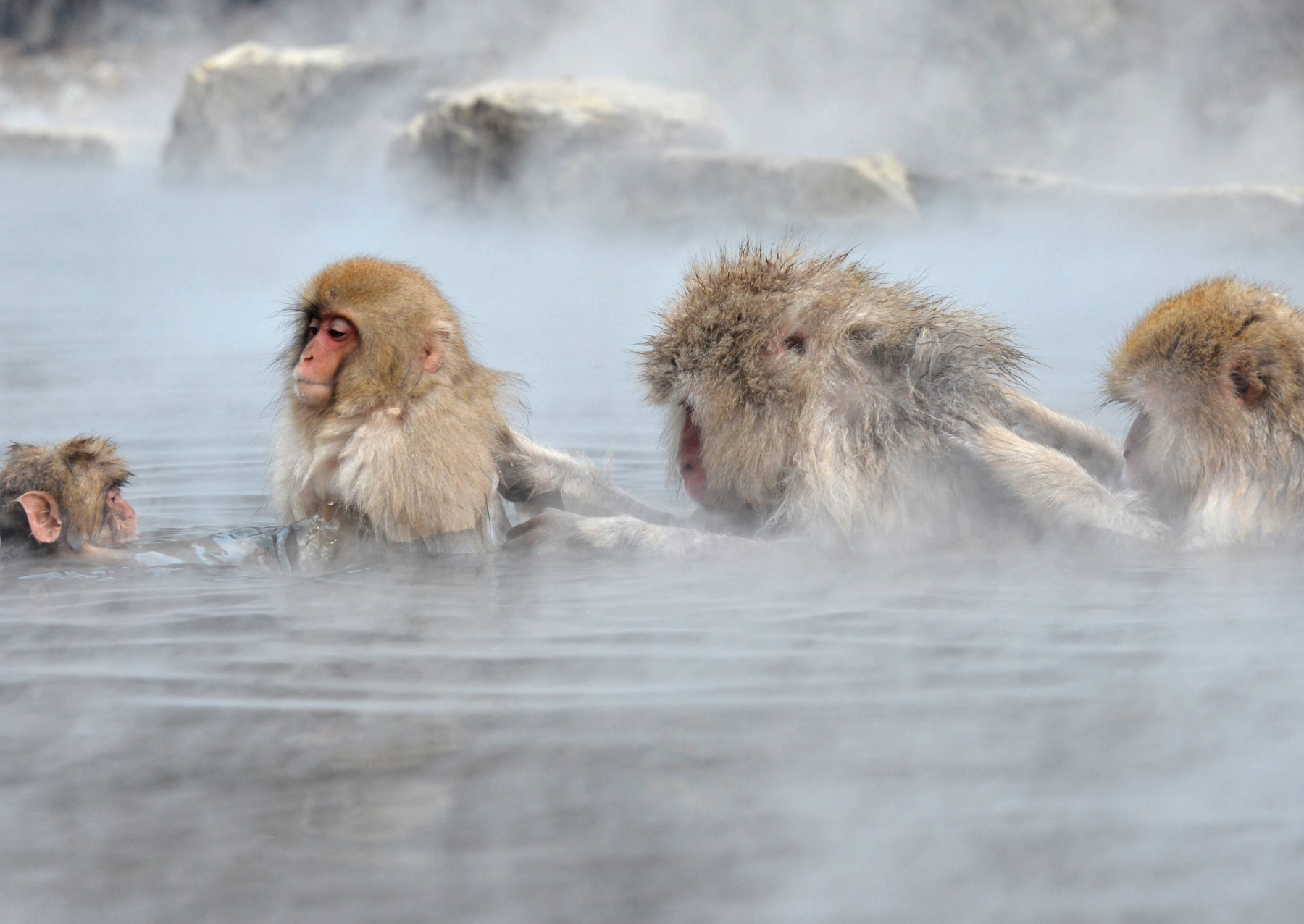
They found that bathing in hot springs subtly reshapes the snow monkeys’ relationships with their parasites and gut microbes. The macaques that bathe showed different lice distributions and gut bacteria. Soaking in the warm water may disrupt louse activity or egg placement within their fur.
As for the gut microbes, the team observed similar subtle shifts. Overall microbiome diversity was similar between bathers and non-bathers. However, several types of bacteria were more abundant in the monkeys who did not bathe. Despite concerns that shared hot springs may increase exposure to intestinal parasites, the bathing macaques did not have higher parasite infection rates or intensities than those that stayed out of the water.
According to the team, these results demonstrate how behavior can shape the parasites and microbes living on and inside an organism and are an important driver of animal health. It also underscores just how complex behavior-health links are in wild animals, suggesting that hot spring bathing influences some host-organism relationships, but not others.
“Behavior is often treated as a response to the environment,” Langgeng added. “But our results show that this behavior doesn’t just affect thermoregulation or stress: it also alters how macaques interact with parasites and microbes that live on and inside them.”
Showing that animal behavior can selectively shape what types of microorganisms are living on their fur or inside their guts can help researchers understand how actions that influence animal health evolved. It can also help us better interpret changes in the microbiome in social animals.
While more research is needed, it also shows parallels to how human cultural practices such as bathing can affect microbial exposure. While clean water is essential for health, this work challenges the assumption that sharing water sources in natural conditions like hot springs increases disease risk.

2025 PopSci Best of What’s New
