

Close Menu
bkngpnarnaul
  • Home
  • Education
    • Biology
    • Chemistry
    • Math
    • Physics
    • Science
    • Teacher
  • E-Learning
    • Educational Technology
  • Health Education
    • Special Education
  • Higher Education
  • IELTS
  • Language Learning
  • Study Abroad

Subscribe to Updates

Please enable JavaScript in your browser to complete this form.
Loading
What's Hot

Canada launches CAD$1.7bn investment to recruit 1,000 global researchers

December 13, 2025

Beyond the Hype: How Human-Centered Leadership Shapes the Future of AI in Education

December 13, 2025

27 Fun Food Web and Food Chain Activities

December 13, 2025
Facebook X (Twitter) Instagram
Saturday, December 13
Facebook X (Twitter) Instagram Pinterest Vimeo
bkngpnarnaul
  • Home
  • Education
    • Biology
    • Chemistry
    • Math
    • Physics
    • Science
    • Teacher
  • E-Learning
    • Educational Technology
  • Health Education
    • Special Education
  • Higher Education
  • IELTS
  • Language Learning
  • Study Abroad
bkngpnarnaul
Home»Math»Interactive step-by-step guide for adding fractions with visual models
Math

Interactive step-by-step guide for adding fractions with visual models

adminBy adminDecember 13, 2025No Comments4 Mins Read0 Views
Share Facebook Twitter Pinterest LinkedIn Tumblr Email WhatsApp Copy Link
Follow Us
Google News Flipboard Threads
Interactive step-by-step guide for adding fractions with visual models
Share
Facebook Twitter LinkedIn Pinterest Email Copy Link


See, understand, and master adding fractions with visual models


When adding fractions there are four important things you need to know and it is very important to keep these in mind to avoid common pitfalls. You could take the interactive fraction quiz to see how much you know! 

  • You cannot add the denominators, also called bottom numbers!
  • You can only add the numerators, also called top numbers!
  • You can add the numerators only when the denominators are the same!
  • If the denominators are not the same, look for a common denominator before adding the numerators.

Why Can’t You Add The Denominators When Adding Fractions?  

Let’s illustrate why it does not make sense to add the denominators using an easy example. The figure below shows the wrong way to add 1 / 2 and 1 / 2. This mistake is quite common when learning fractions for the first time!
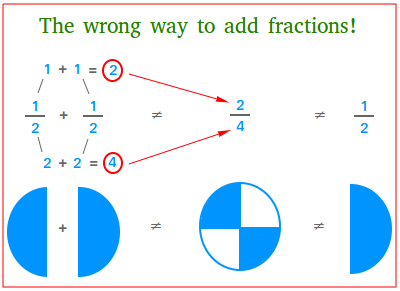
The wrong way to add fractions!

According to the figure above, if you could add the denominators, it would mean that adding half and half will still give half. Does this make sense? Of course not! 

We all know that half a pizza plus another half of the same pizza is equal to 1 pizza as the following figure shows.
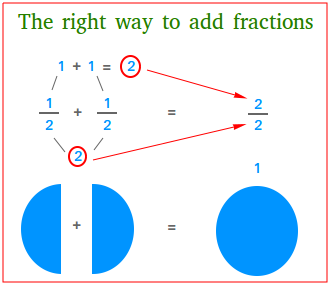
The right way to add fractions!

What have we learned so far?

  • You can only add the numerators when the denominators are the same for both fractions.
  • Since we don’t add the denominators, the denominator stays the same.

Therefore, 1/2 + 1/2 = 1

Example #1

Add: 3/2 and 1/2

Observe that both fractions have the same denominator, which is 2. This means you can add the numerators (3 + 1 = 4) and your denominator will stay the same.


3

2

+


1

2

=


(3 + 1)

2


3

2

+


1

2

=


4

2


3

2

+


1

2

=
2

What Do We Do Then When Adding Fractions With Different Denominators?

When the denominators are different. you need to find equivalent fractions that give a common denominator for both fractions. All you need to do is the look for the least common multiple (LCM) of the denominators. 

Example #2:


2

3

+


3

6

Did you make the following observations for example #2 below?

  • The denominator is not the same for both fractions, so we cannot add 2 and 3 to get 5.
  • You need to look for a common denominator and then you can add the numerators.

Since 6 is the least common multiple of 3 and 6, you can use 6 as a common denominator.

Multiply the numerator and the denominator of 2 / 3 by 2, you will get 4 / 6


2

3

+


3

6

=


(2×2)

(3×2)

+


3

6


2

3

+


3

6

=


4

6

+


3

6


2

3

+


3

6

=


(4+3)

6


2

3

+


3

6

=


7

6

Example #3:


3

5

+


2

4

Notice that it is not easy to multiply one denominator by a number to get the second denominator as we did before in example #2.

As a rule of thumb, when the denominators do not have any common factor(s), you can just multiply them to get a common denominator. Since 4 and 5 have no common factors, the common denominator is 4 times 5 = 20.


3

5

+


2

4

=


(3×4)

(5×4)

+


(2×5)

(4×5)


3

5

+


2

4

=


12

20

+


10

20


3

5

+


2

4

=


(12+10)

20


3

5

+


2

4

=


22

20

Quiz completed 0 times

If you understand the lesson about types of fractions and the lesson about comparing fractions, this lesson will be easy to follow. Check also fractions worksheets, where you can find a variety of worksheets about addition, subtraction, multiplication, and division of fractions in PDF format.


Source link

Adding fractions Guide Interactive models StepbyStep Visual
Share. Facebook Twitter Pinterest LinkedIn Tumblr Email WhatsApp Copy Link
thanhphuchoang09
admin
  • Website

Related Posts

Math

Hyperbolic Spin Liquids

December 12, 2025
Math

Top 5 Trickiest Mathematics Questions From Around the World

December 11, 2025
IELTS

Linking Words to Get Fluent in English (IELTS Speaking Guide for 2025)

December 10, 2025
Math

Highest Common Factor |Find the Highest Common Factor (H.C.F)|Examples

December 10, 2025
Math

Growth rates of sequences governed by the squarefree properties of its translates

December 9, 2025
Math

Wolfram Neural Networks Boot Camp 2026

December 8, 2025
Add A Comment
Leave A Reply Cancel Reply

You must be logged in to post a comment.

Top Posts

Announcing the All-New EdTechTeacher Summer Learning Pass!

May 31, 202550 Views

Improve your speech with immersive lessons!

May 28, 202545 Views

Hannah’s Spring Semester in Cannes

May 28, 202539 Views

Why Are Teachers Burned Out but Still in Love With Their Jobs?

May 30, 202535 Views
Don't Miss

How Do I Find A Study Abroad Program that Matches My Major?

By adminDecember 11, 20250

176 If you’re a college student planning to study abroad, your major is likely one…

Winter Holidays Around the World: Seasonal Celebrations Abroad

December 7, 2025

Introducing AIFS Abroad’s Spring 2026 Green Ambassadors

December 3, 2025

Meet Two People Who Did an Internship Abroad in Lisbon, Portugal

November 29, 2025
Stay In Touch
  • Facebook
  • Twitter
  • Pinterest
  • Instagram
  • YouTube
  • Vimeo

Subscribe to Updates

Please enable JavaScript in your browser to complete this form.
Loading
About Us
About Us

Welcome to Bkngpnarnaul. At Bkngpnarnaul, we are committed to shaping the future of technical education in Haryana. As a premier government institution, our mission is to empower students with the knowledge, skills, and practical experience needed to thrive in today’s competitive and ever-evolving technological landscape.

Our Picks

Canada launches CAD$1.7bn investment to recruit 1,000 global researchers

December 13, 2025

Beyond the Hype: How Human-Centered Leadership Shapes the Future of AI in Education

December 13, 2025

Subscribe to Updates

Please enable JavaScript in your browser to complete this form.
Loading
Copyright© 2025 Bkngpnarnaul All Rights Reserved.
  • About Us
  • Contact Us
  • Disclaimer
  • Privacy Policy
  • Terms and Conditions

Type above and press Enter to search. Press Esc to cancel.