


If you’ve been in special education for any amount of time, you already know that the word “data” follows us everywhere. Especially when it comes to behaviors and behavior support plans. For a long time, behavior data was the one area that made me feel like I was constantly trying to catch up. I always felt like I was tracking something… I just wasn’t always sure what that something was. My students in the Resource Room all bring different strengths, personalities, and needs. With that comes a wide variety of behaviors that can shift from day to day. Behavior support quickly became part of my daily routine, whether I was ready or not. And behavior support plans needed to be data-driven. If you’re new here, I teach in a Resource Room setting with students with varying disabilities. Feel free to explore a day in the life of a Resource Room Teacher and a tour of my Resource Room.

How I Found My Rhythm With Behavior Data
I’ll never forget my first couple of years teaching, when I tried nearly every possible way to track behavior. I had printed forms, binders that I swore I would keep organized, notes written on whatever paper I could find… It was a lot. With time, experience, and quite a bit of reflection, I realized that behavior data only becomes useful when it paints a clear picture. Once I started noticing patterns, things made more sense. I saw what happened before the behavior, how the student reacted, and what followed. My Behavior Support Plans became more accurate and more helpful for everyone involved. This Data Sheets Bundle really is what helped me the most.

What Is a Behavior Support Plan?
A Behavior Support Plan, or BSP, is a plan for helping a student succeed when challenging behaviors come up. It’s built from data, not assumptions. It lays out what the behavior looks like, why it might be happening, and what strategies can support the student moving forward. A strong BSP doesn’t focus on punishment or “fixing” the student. Instead, it focuses on what the student needs to be successful. Usually, that includes proactive strategies to prevent the behavior, replacement skills to teach, and clear steps for staff to follow if the behavior occurs. When everyone is consistent and working from the same plan, the student has consistency, the environment becomes calmer, and the team feels more confident in how to support the student. This is why data is super important. It keeps the plan accurate, supportive, and student-centered. Here is another great article discussing 5 Steps to Writing a Behavior Support Plan.

What is ABC Data?
ABC data is one of the most important tools we have for understanding behavior. It breaks everything down into three simple parts: Antecedent, Behavior, and Consequence. The Antecedent is whatever happened right before the behavior. This can be a trigger, demand, transition, noise, change, or even the lack of attention. The Behavior is the student’s observable action, described in clear, neutral terms. The consequence is what happened immediately after the behavior, including how adults responded or what naturally followed. When you collect ABC data across several days or situations, patterns start to surface. Here’s a link to a free ABC Data Sheet you can use to get started!

Why Data-Driven Plans Make Such a Difference
There was a point where I tried to design all my own forms, thinking it would simplify things. Instead, it left me with too many versions of the same tool and no real consistency. Once I focused on collecting the appropriate data, things made more sense. I began identifying triggers, noticing patterns, and understanding the purpose of the behavior. The process became much clearer. It was like everything went into place. I wasn’t guessing anymore. I could make decisions with confidence because the data provided answers. And when you’re supporting behavior, that’s super important.

Digital Behavior Tracking: A Quiet Miracle
For the longest time, I was hesitant to go digital. I assumed it would take more time or distract from what was happening in the moment. But once I started using Google Forms for behavior tracking, I realized how much time I had been wasting trying to organize everything manually. Being able to log something quickly, see patterns emerge automatically, and share forms with paraprofessionals or teachers made a huge difference. The ability to give staff access through a simple QR code was surprisingly helpful. Instead of searching for a clipboard, they could enter the information right away, which made our data much more accurate and consistent across settings.

But Yes… I Still Use Paper Sometimes
Even with how helpful digital tools are, I still appreciate the simplicity of a printed form. There are moments, especially during transitions or hands-on activities, when grabbing a pen is just the fastest option. Paper allows for quick notes, side observations, or clarifications that don’t always fit into a digital form. It’s not fancy, but it’s dependable, and it still has a place in my behavior tracking system.

QR Codes, Confidentiality and all Things Data
The data bundle I’ve found gives you all the data goods you could wish for. The bundle includes so many different data forms you can use in all areas of special education. The tutorial also gives you instructions on how to create a QR code. This allows staff to use their phones or a tablet to scan the QR code and pull up the Google Form to use to track the data. It even comes with directions on how to password protect your forms! How amazing is that? In today’s world and in this field especially, confidentiality is our top priority.

All Kinds of Data
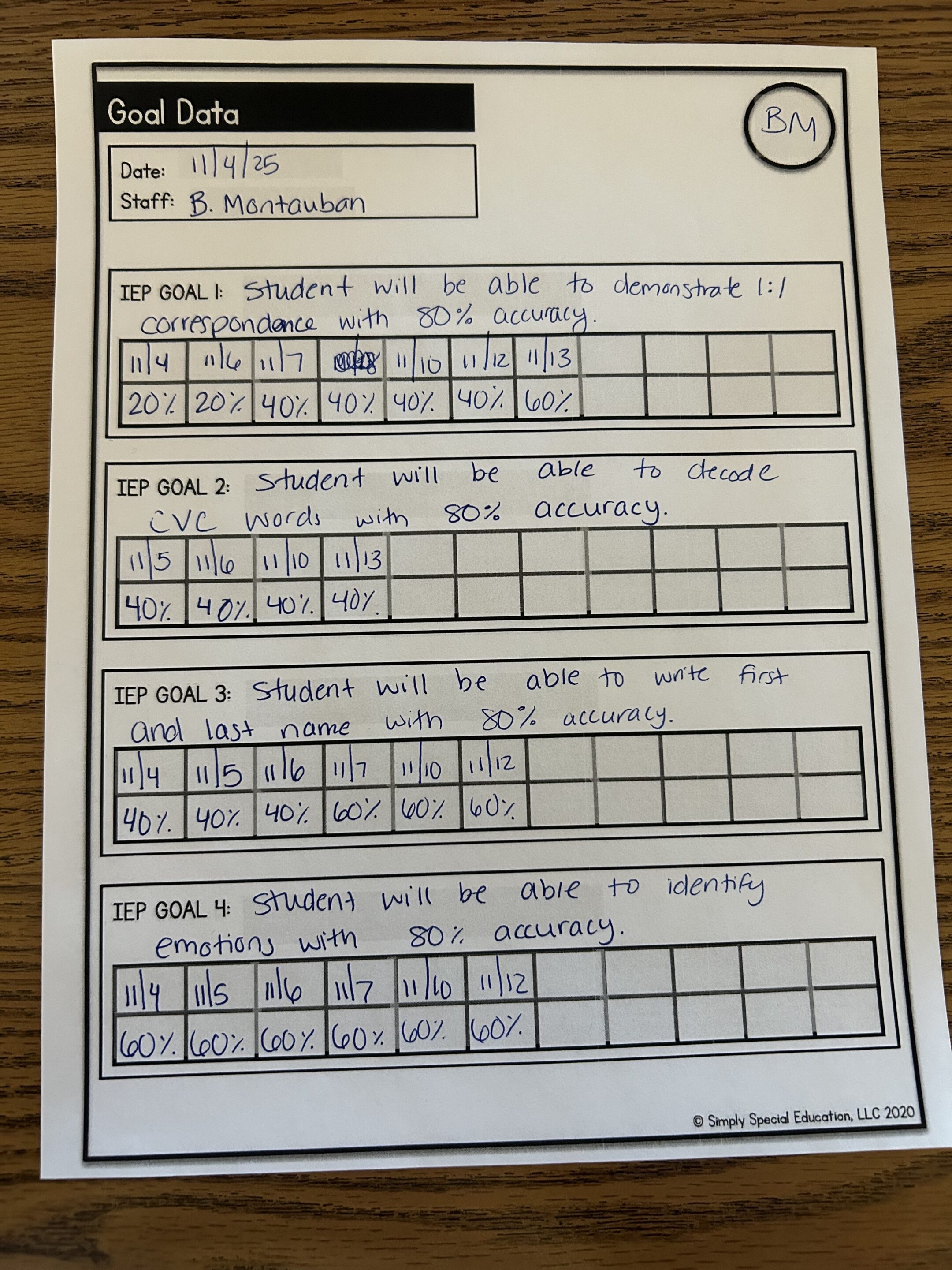
This Data Sheets Bundle is so versatile, too. You can track any goals your students may have. The digital version includes 37 editable pages that cover just about every kind of data you could need. Some examples include goal tracking, daily data, behavior, toileting, morning routines, community outings, and even handwashing and toothbrushing data.

Level of Support Needed
There’s also a spot to include a key at the top of the page. You can track if a student is completing this goal independently (+), with a full prompt (-), or with a partial prompt (PP). These are very helpful in documenting the level of independence in which a student achieves a goal. You can change that to track whatever is needed. You can write in the key yourself, type it in, or use the already typed template. It’s really such a versatile tool that makes the data collection world so much easier!

Focus on the Data
Behavior Support Plans don’t have to feel overwhelming. With the right tools, clear data, and a system that works, you can create plans that actually support your students and make your day-to-day a little easier. Remember, it’s not about perfection, it’s about consistency, understanding, and using meaningful data to guide your decisions. With resources like these, you can feel confident that the plans you put in place are practical, effective, and truly student-centered.

Progress Monitoring: Data Driven
Oh, and there’s even a bonus! There’s a template (and it’s editable) and an example of a progress monitoring schedule. I mean, like what?! This bundle really does have it all. But hey, stop taking my word for it and go ahead and buy it from the Simply Special Ed Shop. I’m telling you… it is beyond worth every penny! It doesn’t matter what type of Special Education you teach, it would even be beneficial for a Speech and Language provider also! Seriously, check it out! And if you’re like me and absolutely love this bundle, you should check out this awesome IEP Binder Resource and this Para Professional Binder Resource to really make your life as a Special Educator easier!