


Fifty years ago, Congress dramatically expanded schools’ responsibilities when it passed the nation’s primary special education law, requiring children with disabilities to receive a “free appropriate public education” alongside their non-disabled peers.
The Education for All Handicapped Children Act, as it was then called, required schools to identify students with disabilities and make individualized plans to meet their needs.
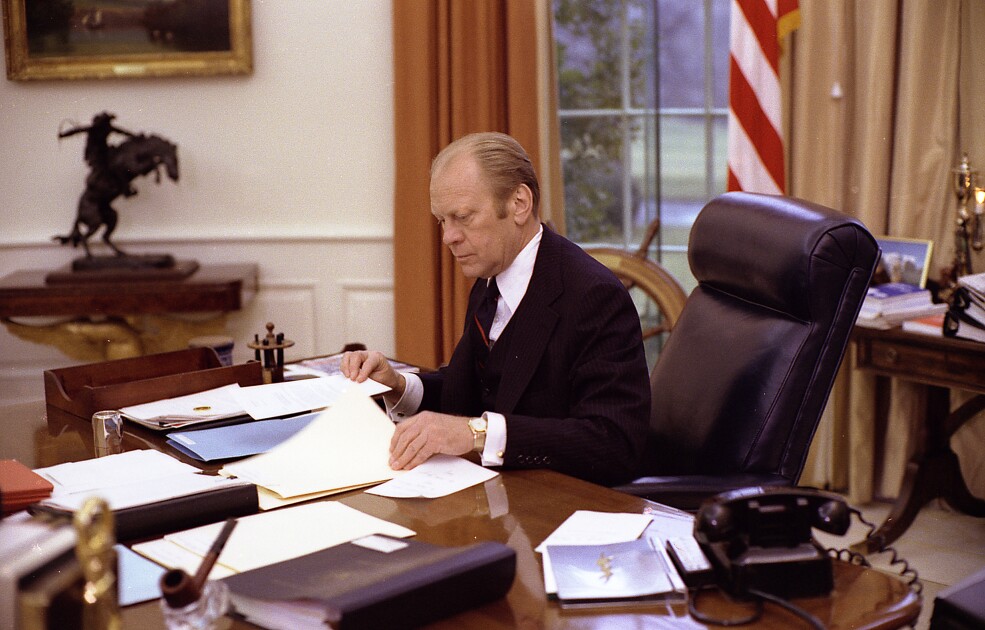
Disability rights advocates celebrated the law. But even as President Gerald Ford signed it on Dec. 2, 1975, he expressed concerns that Congress would not be able to provide adequate funding to meet its detailed mandates.
“Everyone can agree with the objective stated in the title of this bill—educating all handicapped children in our nation,” Ford said in a signing statement. “The key question is whether the bill will really accomplish that objective.”
The landmark legislation was reauthorized as the Individuals with Disabilities Education Act, or IDEA, in 1990, and amended again in 1997 and 2004. Fifty years after its initial passage, advocates for students with disabilities fear its promise is under threat, both from the original concern Ford expressed—inadequate funding—and from newer issues, like changes in federal education policy..
Here are four things to know.
The number of students with disabilities has grown steadily over time
Part B of IDEA outlines states’ requirements to provide a free appropriate public education, or FAPE, by identifying students with disabilities and creating individualized education programs to outline goals and supports.
About 3.6 million students—8% of overall public school enrollment—were identified under Part B when the law first took effect in 1976. That number climbed to 7.5 million in the 2022-23 school year, about 15 percent of total enrollment, the most recent federal data show.
That increase was fueled by several factors, including increased efforts to identify students with disabilities at earlier ages, broader diagnostic criteria, and the later addition of autism, traumatic brain injuries, and developmental delays as disability categories.
Thirty-two percent of students served under the law have a specific learning disability, like dyslexia or dysgraphia, making it the largest disability category. The other large categories include speech and language impairments like stuttering (19%); “other health impairments” like ADHD or epilepsy that impact learning by affecting issues like attention or focus (15.3%); and autism (13%).
Federal funding for IDEA is well below targets outlined in the law
When Congress passed the Education for All Handicapped Children Act, it recognized that the new obligations for schools created under Part B of the law would create new expenses.
To cover “excess costs” associated with providing services to students with disabilities, the law created a graduated federal spending schedule. By 1982 and all of the years going forward, “the maximum amount” of each state’s grant under Part B would be equivalent to 40% of overall average per-pupil costs in the United States multiplied by the number of children in the state identified under the law.
Appropriations are handled separately by Congress, and decades later, it has never come close to meeting that 40% threshold. Educators and advocates see it as an unfulfilled promise. In the 2024 fiscal year, the $14.2 billion in Part B grants provided to states was equivalent to 10.9% of the average per pupil expenditure, well short of the 40% target, the Congressional Research Service said in an August 2024 report.
Bipartisan groups of senators and representatives have repeatedly introduced bills to “fully fund” IDEA that have not advanced to a vote. The most recent version, proposed in April, would mandate gradual increases in federal funding over 10 years, requiring Congress to reach the 40% threshold by 2035.

Special education teacher shortages remain a top concern for schools
School leaders consistently rank difficulty recruiting and and retaining special education teachers as a top staffing concern, and some advocates say turnover in the role affects the quality of services students receive.
Thirty-four percent of public school leaders reported understaffing in special education in an Oct. 2024 federal survey. By comparison, 22% reported shortages in general elementary education positions.
That shortage is in part due to a persistent trend of teachers with special education certification shifting to general education classrooms, rather than leaving the teacher profession entirely, researchers have found. That may be because of the stresses of the job: paperwork, additional legal responsibilities, case management, and limited resources.
Advocates have pushed for strategies like teacher residencies that allow special education candidates to learn in the classroom with additional support from a certified teacher, bonuses for special education teachers in high needs areas, and mentoring programs that give special educators a backstop on the complicated aspects of their work.
Advocates sound the alarm over IDEA enforcement worries
Implementation of IDEA has always been imperfect; the U.S. Department of Education found just 19 states met the law’s requirements in 2025. The agency reviews states’ plans to comply with IDEA and key data related to academic progress, discipline and learning environments for students with disabilities. States that don’t meet requirements must seek federal technical assistance or target funding to areas that need improvement.
But changes by President Donald Trump’s administration have stirred new concerns of weakened federal enforcement of IDEA’s mandates.
In November, the the Education Department announced plans to offload the duties of many of its offices to other federal agencies. Those offices include elementary and secondary education, which will see core responsibilities such as administering Title I and other key funding streams shift to the U.S. Department of Labor under an interagency agreement made without congressional approval.
Plans to move the office of special education and rehabilitation services and the office for civil rights, which investigates legal complaints about schools’ treatment of students with disabilities, to other agencies remain on the table, administration officials said. Even if those offices remain in the Education Department, spreading federal education programs across agencies will increase bureaucracy and put vulnerable students at risk, critics have said.
The Trump administration has also terminated millions of dollars in grants for special education teacher training and other special education projects, attempted to reduce special education oversight staff, and closed seven of 12 regional offices operated by the office for civil rights. About 33% of the 25,000 complaints OCR received in 2024 were related to disability rights, the agency said in a report to Congress, and that category historically has been proportionally among the largest.
