



by TeachThought Staff
At TeachThought, we’re enthusiastic supporters of any learning taxonomy. (We even created our own, the TeachThought Learning Taxonomy.)
Put simply, learning taxonomies help us think about how learning happens. Even if they’re ‘not good’ as we’ve often seen the DOK framework described, they still highlight that there are many ways to frame thinking and give us practice in realizing that potential.
Bloom’s Digital Taxonomy Verbs adapt Bloom’s original cognitive framework for digital learning, helping K-12 teachers integrate technology while building essential thinking skills. The taxonomy organizes digital actions into levels like remembering, understanding, applying, analyzing, evaluating, and creating, each with tech-based verbs that support specific learning goals.
This means that we can have taxonomies for differentiation and taxonomies for thinking and taxonomies for tasks and assessment–so many possibilities for examining the actual process of thinking, learning, and the application of each.
This leads to cool visuals–Bloom’s Taxonomy posters, for example.
It can also lead to tools that help to design lessons, units, and assessments–Bloom’s Taxonomy verbs work well here.
You can get a ready-for-the-classroom version of Bloom’s Digital Taxonomy for $6.95.
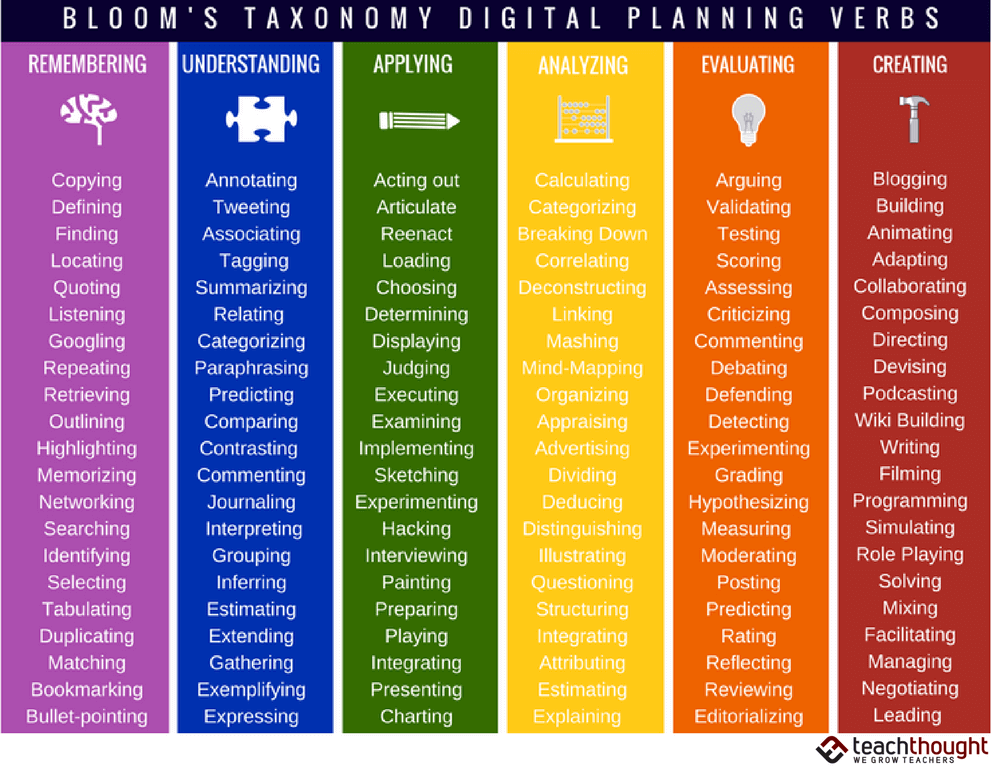
And it can lead to further splintering of the concept, like this graphic that merges 21st-century learning, modern digital and social spaces, and Bloom’s Taxonomy in one framework. This TeachThought graphic provides 126 power verbs for digital learning–a kind of Bloom’s Digital Taxonomy that relies on the existing Remember–Understand–Apply–Analyze–Evaluate–Create and then provides common digital tasks like moderating, duplicating, blogging, wiki-building, podcasting, and more.
The result is a tool that can help teachers think about the levels of higher-order thinking that go into these kinds of activities and projects. To be clear, just because a verb is in one category doesn’t mean it can’t also be used at higher or lower levels of thinking (i.e., appear in other categories of Bloom’s Digital Taxonomy).
Looking for a traditional version of Bloom’s verbs? View our Bloom’s Taxonomy Verbs for Teaching and Planning.
Want to see how these verbs align visually with thinking levels? Explore our Bloom’s Digital Taxonomy Chart.
In fact, there is a significant amount of subjectivity and editorializing that goes into any kind framework that purports to outline how thinking happens. It’s not an exact science. Nonetheless, just the fact that we’re exploring thinking and digital tasks and student work together is at least as valuable as any single framework in and of itself.
By doing this kind of work, we collectively–you, TeachThought, administrators, schools, researchers, universities, etc.–can develop ‘fluency’ in the murky and abstract field of applied neurology. We can begin to understand how understanding happens.
Bloom’s Digital Taxonomy Power Verbs
Hopefully you find the graphic useful to explore, discuss, plan, and otherwise participate in Bloom’s Digital Taxonomy.
You can also find a classroom-ready version of our Bloom’s Taxonomy Digital Planning Verbs & Cards to shorten prep time and focus on broader lesson and unit planning strategies for your students.
If you have any verbs you’d like to see added to the chart, let us know in the comments below.
126 Bloom’s Taxonomy Verbs For Digital Learning
Remembering
- Copying
- Defining
- Finding
- Locating
- Quoting
- Listening
- Googling
- Repeating
- Retrieving
- Outlining
- Highlighting
- Memorizing
- Networking
- Searching
- Identifying
- Selecting
- Tabulating
- Duplicating
- Matching
- Curating & Bookmarking
- Bullet-pointing
Understanding
- Annotating
- Tweeting
- Associating
- Tagging (tagging your curriculum for example)
- Summarizing
- Relating
- Categorizing
- Paraphrasing
- Predicting
- Comparing
- Contrasting
- Commenting
- Journaling
- Interpreting
- Grouping
- Inferring
- Estimating
- Extending
- Gathering
- Exemplifying
- Expressing
Applying
- Acting out
- Articulate
- Reenact
- Loading
- Choosing
- Determining
- Displaying
- Revising Search Keywords
- Executing
- Examining
- Implementing
- Sketching
- Experimenting
- Hacking
- Interviewing
- Painting
- Preparing
- Playing
- Integrating
- Presenting
- Charting
Analyzing
- Calculating
- Categorizing (e.g., web content, search results, etc.)
- Breaking Down
- Correlating
- Deconstructing
- Strategic Hyperlinking
- Supporting (e.g., a cause)
- Mind-Mapping
- Organizing
- Appraising
- Advertising
- Dividing
- Deducing
- Distinguishing
- Illustrating
- Questioning
- Structuring
- Integrating
- Attributing
- Estimating
- Explaining
Evaluating
- Arguing & Debating
- Validating
- Testing
- Scoring
- Assessing
- Criticizing
- Commenting
- Iterating or Pivoting (e.g., a startup or app)
- Defending
- Detecting
- Experimenting
- Grading
- Hypothesizing
- Judging
- Moderating
- Posting
- Predicting
- Rating
- Reflecting
- Reviewing (e.g., a service or platform)
- Editorializing
Creating
- Blogging
- Building
- Animating
- Adapting
- Collaborating
- Composing
- Directing
- Devising
- Podcasting
- Wiki Building
- Writing
- Filming
- Programming
- Simulating
- Role-Playing
- Solving
- Remixing
- Facilitating
- Designing (a YouTube Channel, for example)
- Negotiating
- Leading
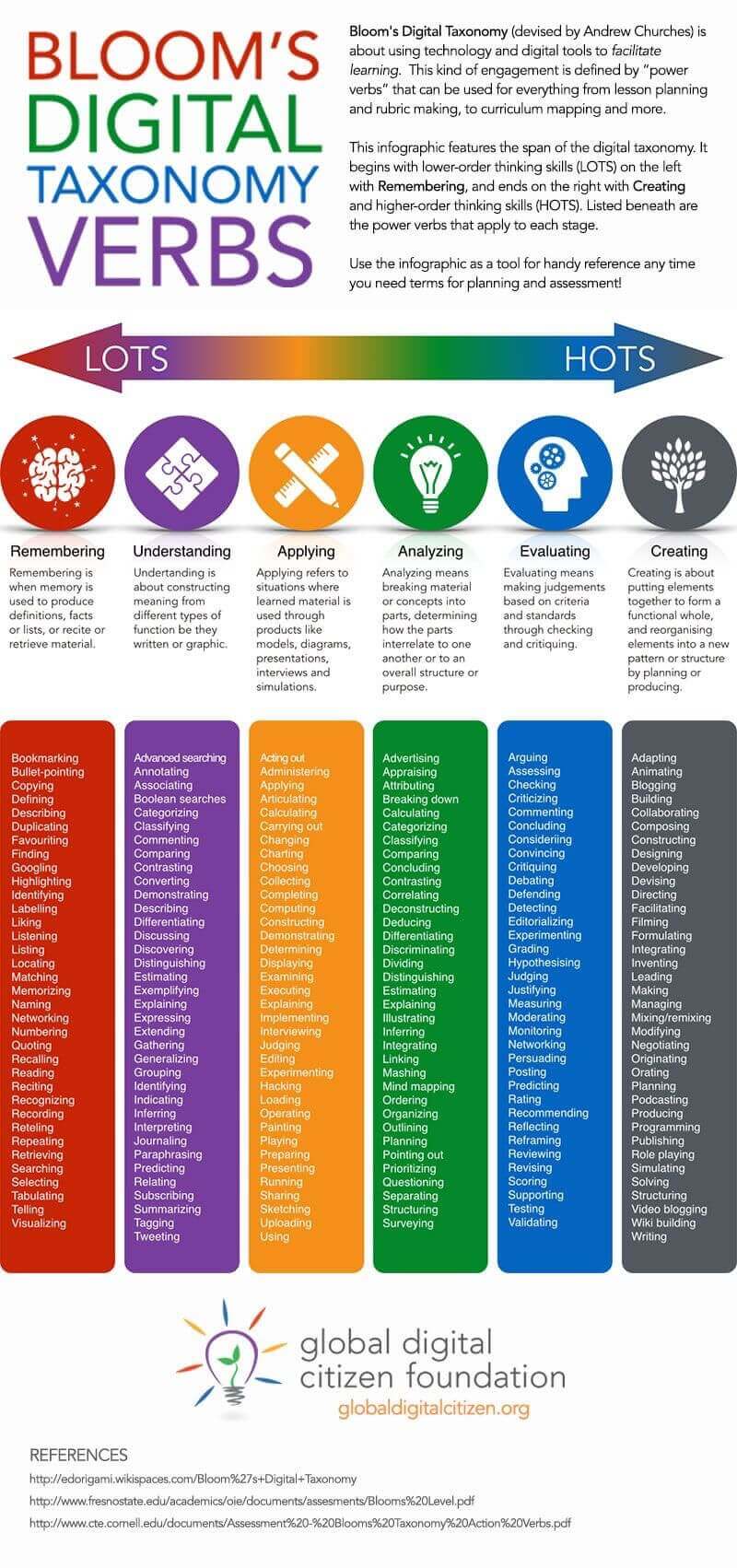
Another version of the graphic from Global Digital Citizen appears below.
TeachThought’s mission is to promote critical thinking and innovation education.
